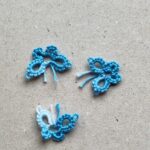
Carolin
 Before I became a mom and a designer, I worked in software development for a long time. And if you really think about it, craft instructions and computer programs have a lot in common. (Strictly speaking, software was even invented in connection with the textile industry—but that’s another story.) Craft instructions and computer programs both define what needs to be done to achieve a specific result. The more clearly they are written, the more reliably the desired outcome is achieved. That’s why the actual programming in software development only makes up a small part of the process. Before any coding can begin, the desired result has to be defined very precisely—this is often referred to as gathering requirements. After the programming is completed, extensive testing is necessary to verify that the software behaves as intended. In practical testing, not only do programming errors come to light, but it often turns out that the original requirements were not entirely correct. In that case, the software has to be revised. All of this only works if the requirements, the software itself, and the tests are carefully documented from the very beginning.
You can probably guess already: when I write a new pattern, there’s a bit more going on behind the scenes than you might expect at first.
Today, I’ll show you how a pattern like this is created, using my Kawaii Sun Lucy as an example for a Patterns .
Sketches
I had two ideas I wanted to bring to life. First, I wanted to design a face that I could incorporate into different designs, and second, I wanted to create a sun. I usually start by sketching my idea with a pencil to get a feel for how the motif should look. Then I begin figuring out how to construct the shape using rings and arcs.
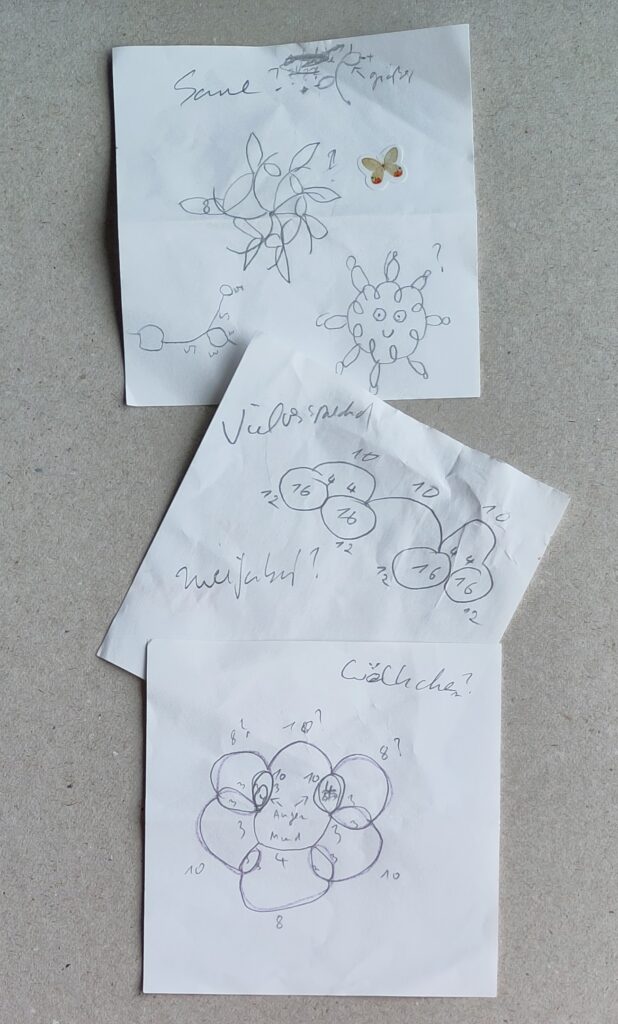
The Face
We’re so used to seeing cute faces in TV shows, on our plush toys, or in advertising that many people don’t realize how much work goes into a simple face made of just a few lines. As humans, we are social beings who live in groups, and reading faces is part of our survival instinct. Even babies are deeply engaged in this process: Who is smiling at me and seems friendly? Who looks stern and might be a threat? It’s no coincidence that we often see faces where there actually are none (for example, in clouds or electrical outlets).
Because our brains are so skilled at reading faces, even a millimeter of line thickness in a mouth or a single degree in the angle of an eye can make the difference between “aww, how cute” and “yikes, how creepy.” That’s the challenge I wanted to take on with Occhi.
Once my first sketches were done, I started knotting to see if my ideas would actually work… well, see for yourself:
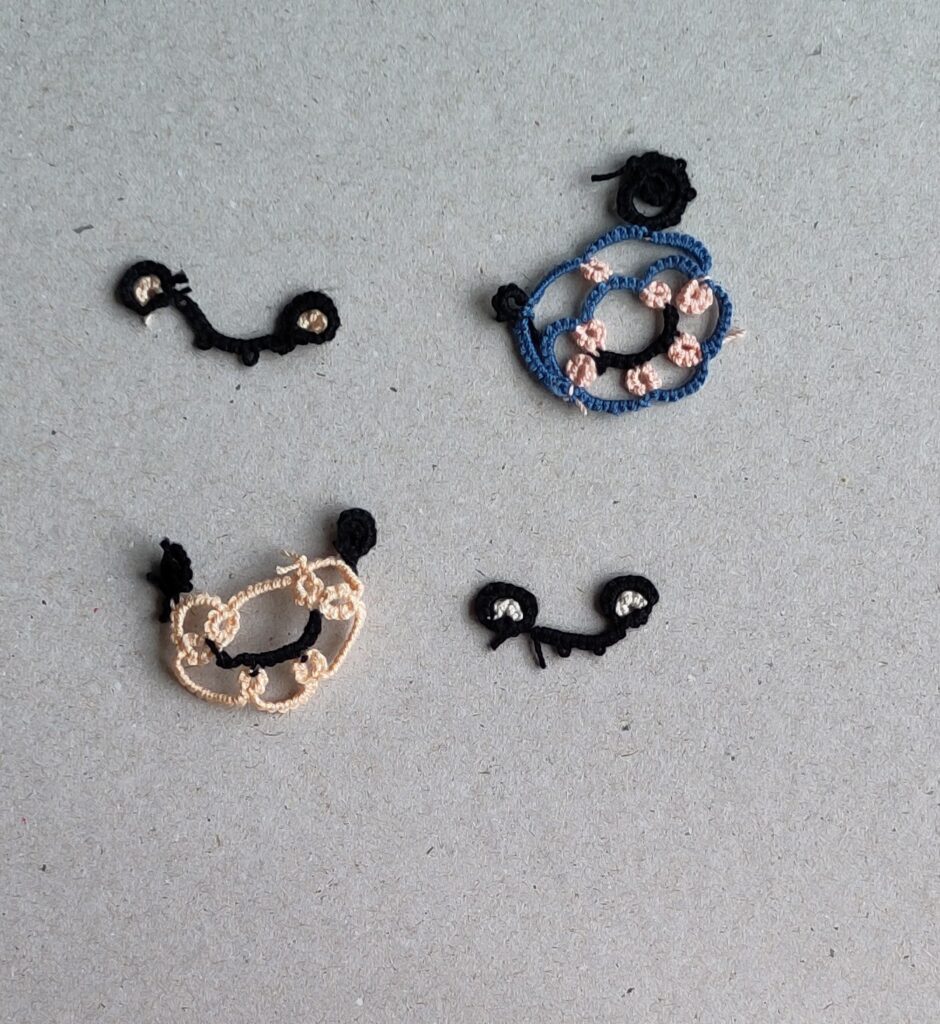
The idea with the supporting structure in the top right and bottom left not only looked terrible, but was also far too large and inflexible to be reused in other designs. After several attempts, I ended up with a very minimal version (top left and bottom right).
What you can’t see here: the four threads of the light eye rings disappear directly during knotting—no sewing in ends required. In the final pattern, I explain this step by step with pictures. Patterns erkläre ich Dir das Schritt für Schritt mit Bildern.
The Sun
Anyone who looked closely at the sketches above will have noticed that I originally had a completely different structure in mind for Lucy. Somehow I just couldn’t make it work, as you can see in the next image. Maybe I’ll revisit that idea for another pattern someday. In the end, I decided on a simpler circular construction.
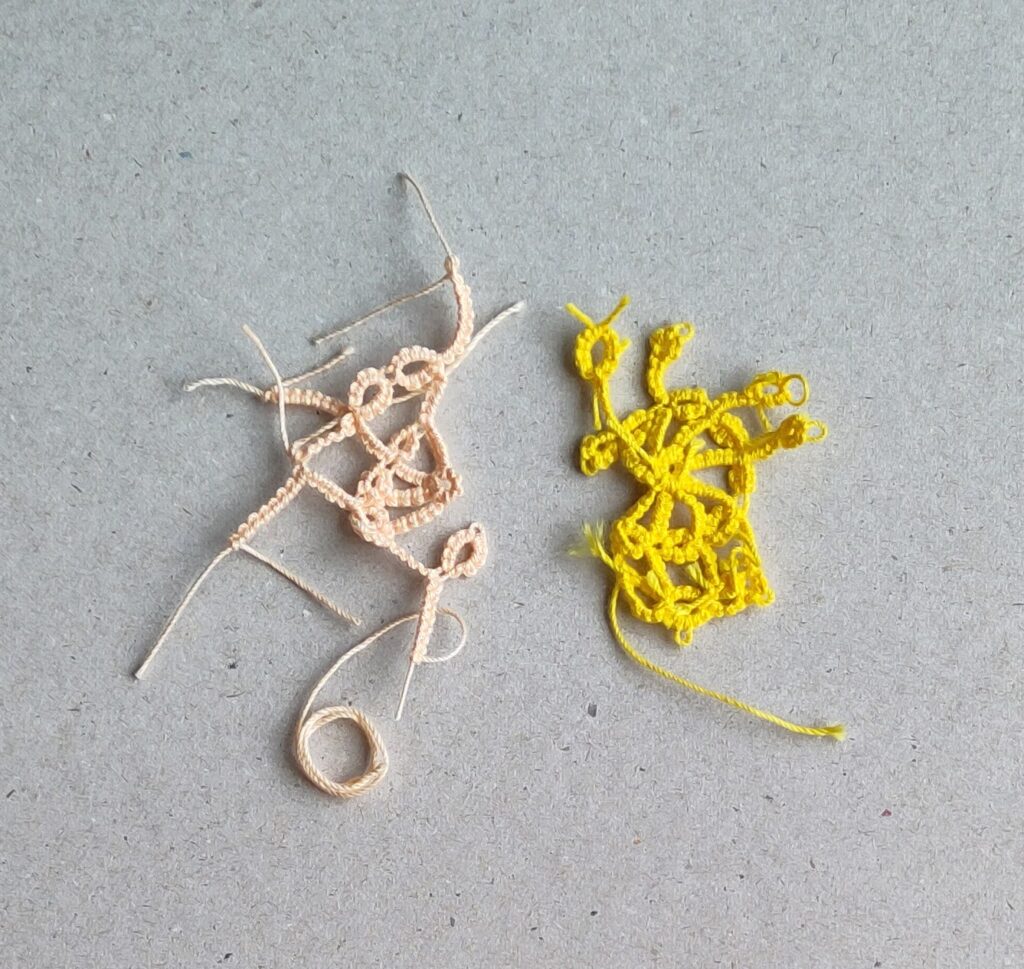
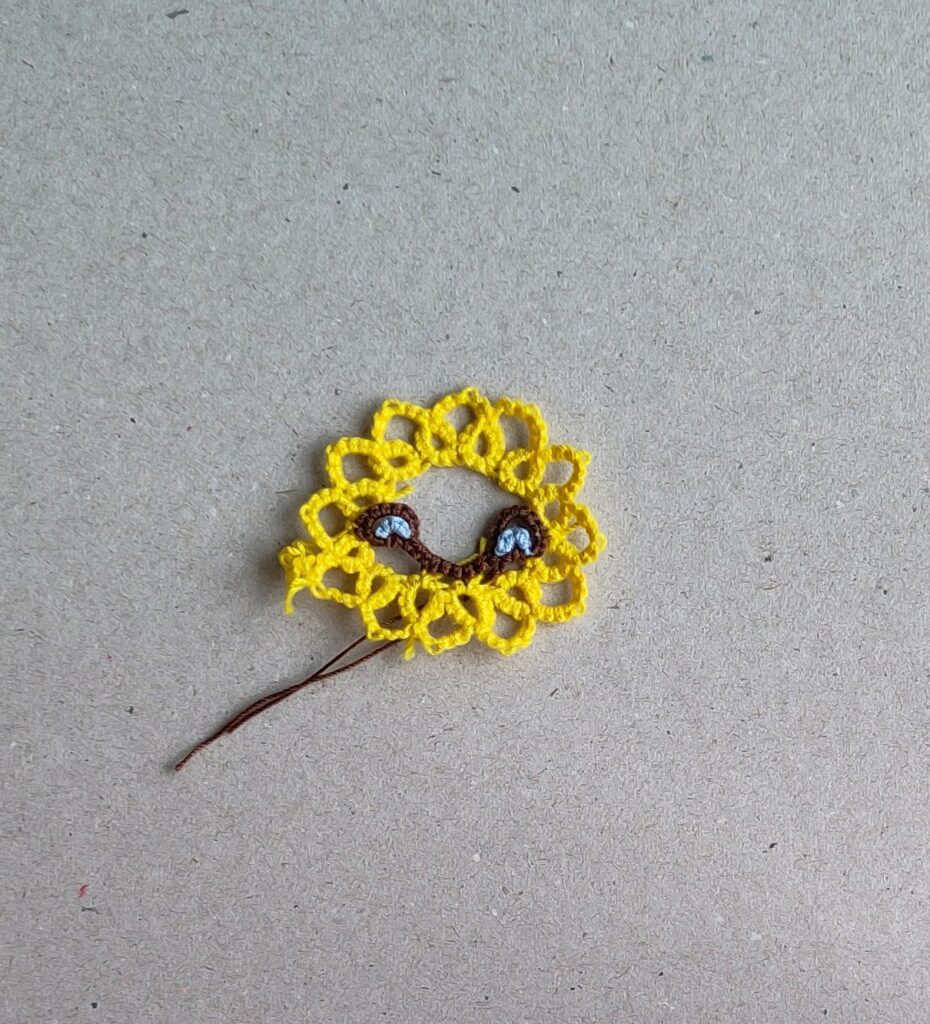
Now Lucy still needed to become bigger and more interesting. With a few sunbeams, she already looked quite nice—but I wanted more, so I added a second circle.
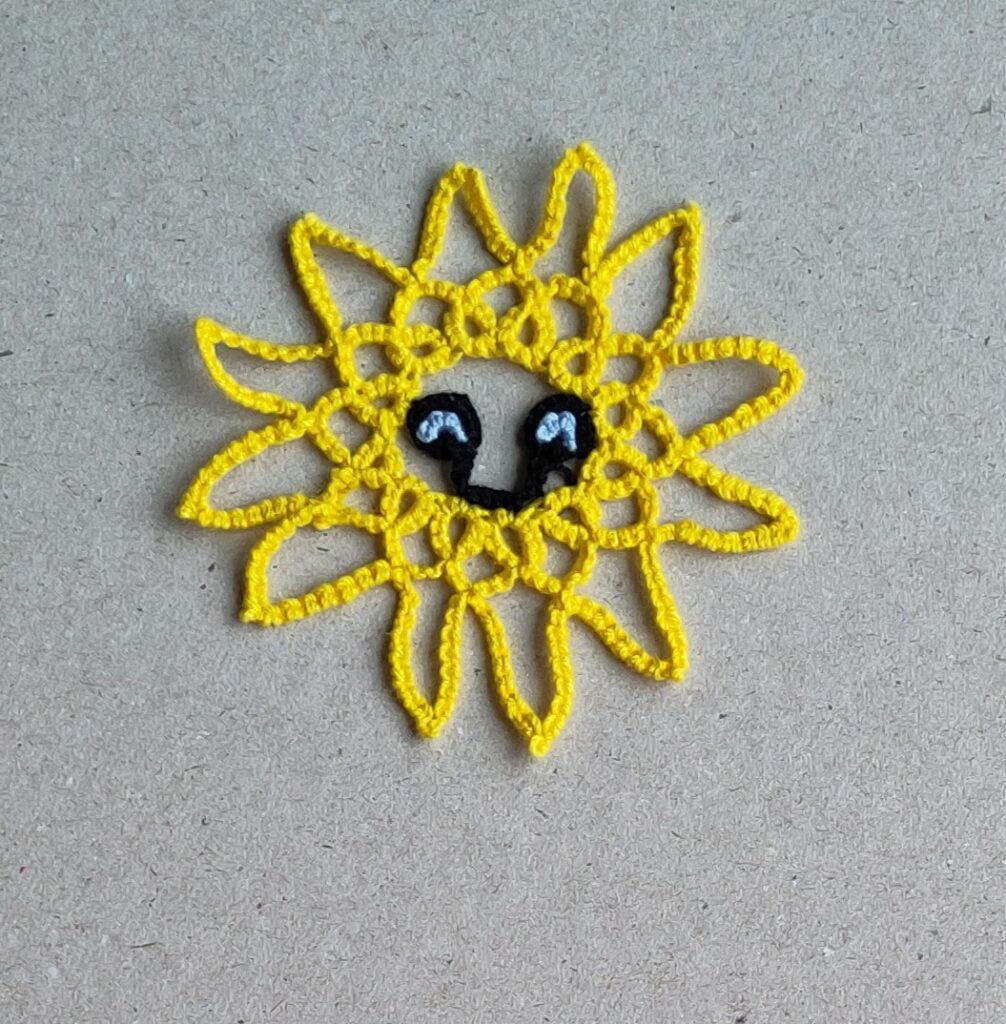
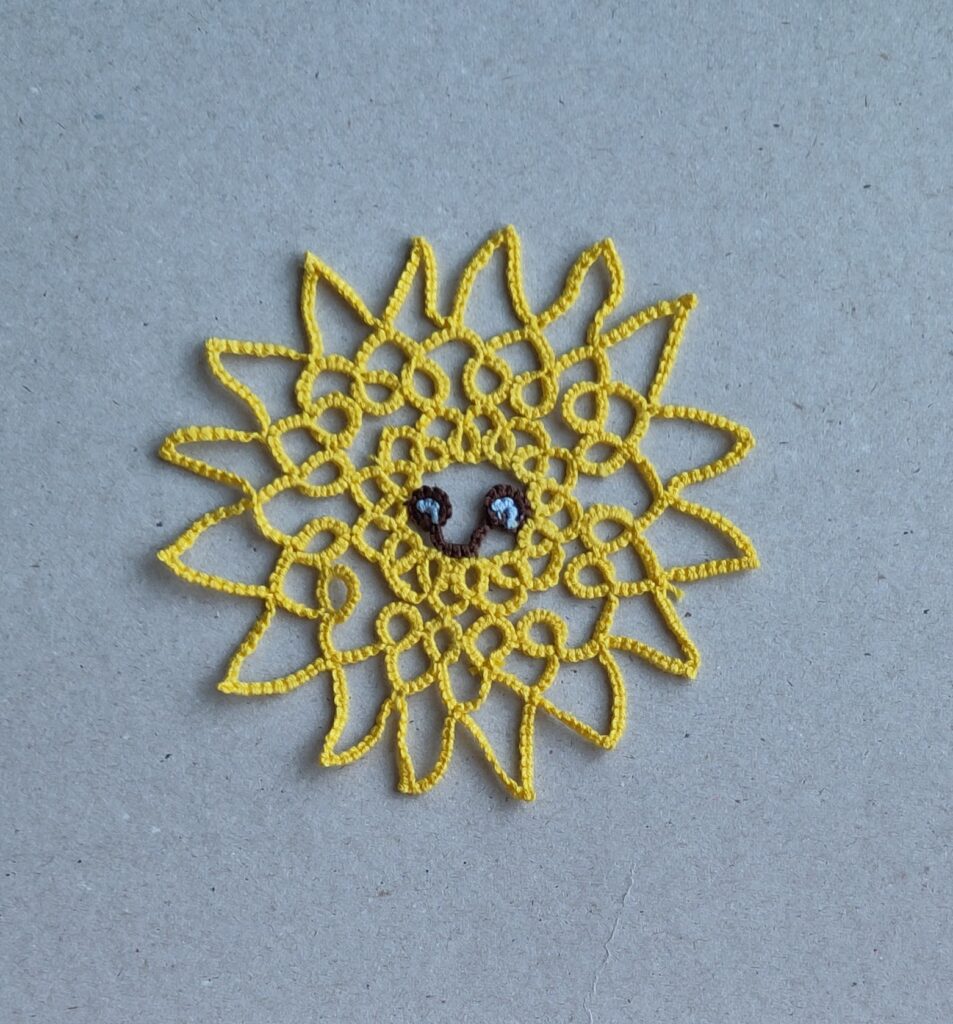
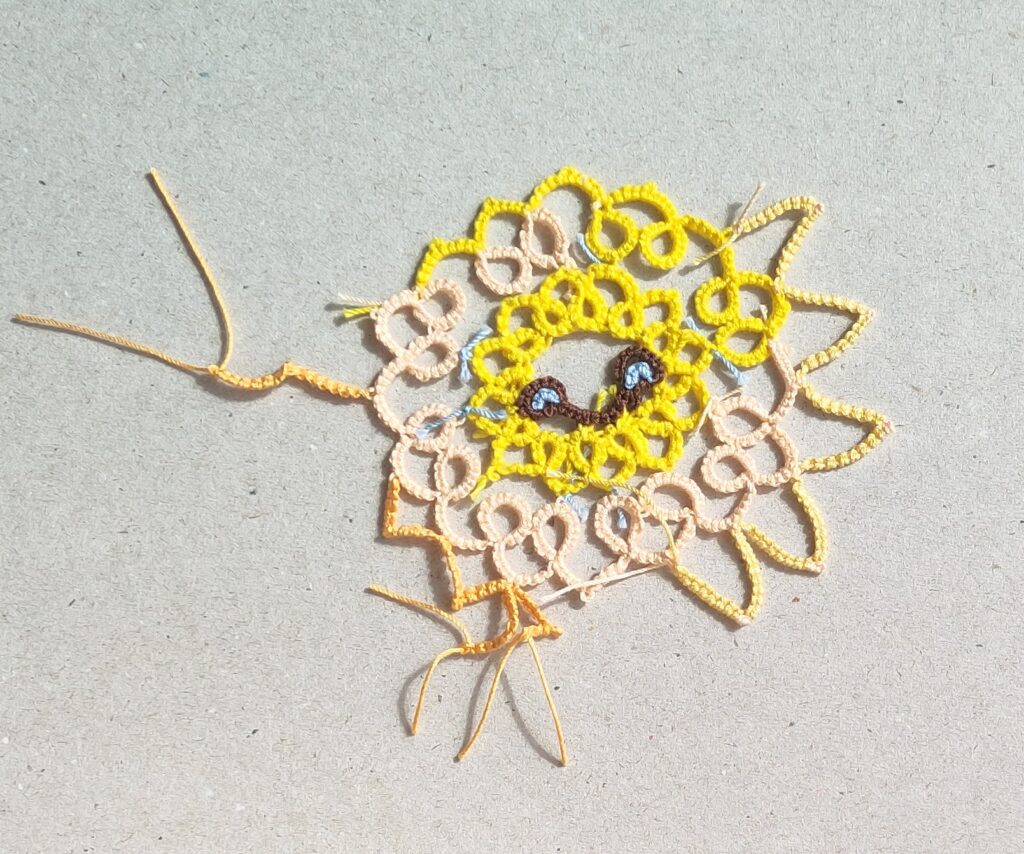
Something about the sunbeams didn’t feel right. I couldn’t quite put my finger on it, so I started experimenting. In the next image, you can clearly see how I used up leftover yarn in different colors (sometimes that even leads to new ideas). If you look closely, you’ll notice that I tried out different versions of the outer sun circle and only attached the final version to the inner circle afterward using blue thread.
At first, I thought the issue with the sunbeams was the knotting technique. To save time during my experiments, I made the sunbeams shorter—and in the end, that turned out to be the key.
The short sunbeams
- are more stable
- lie flatter as a result
- look cuter
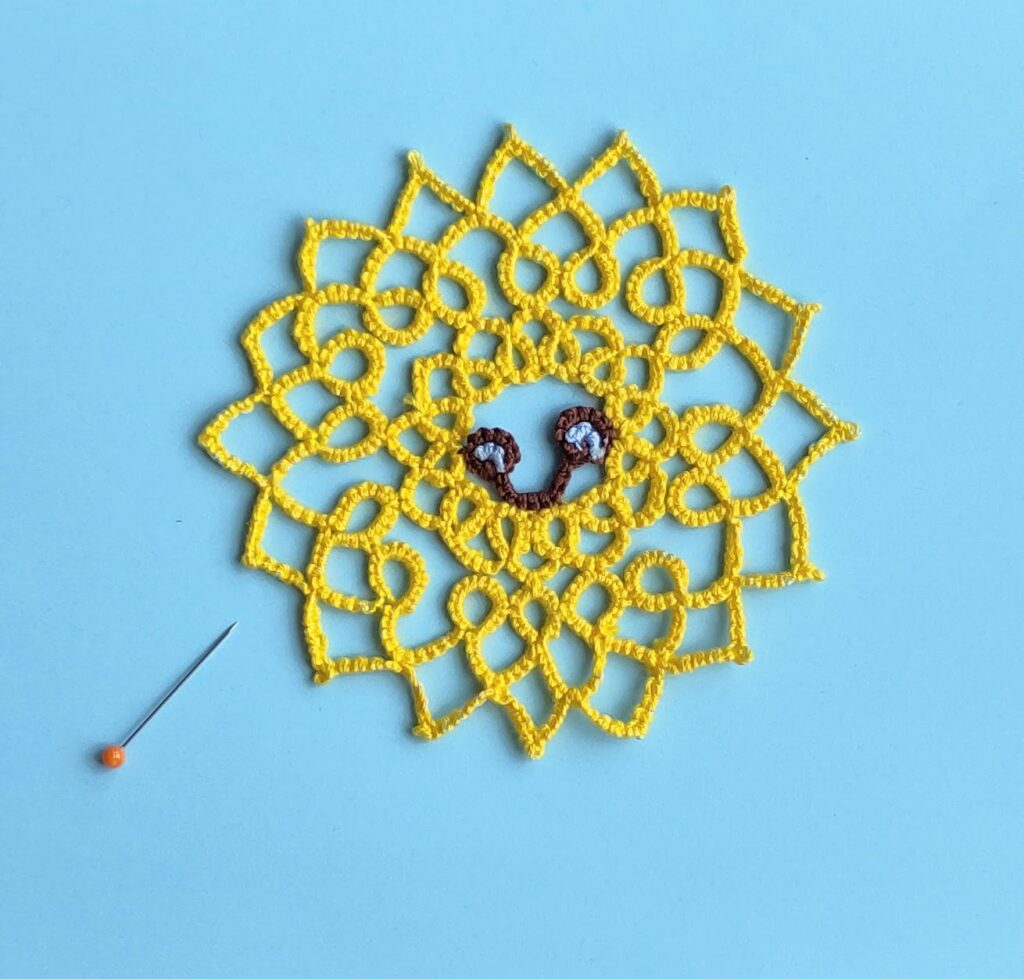
And once I had re-knotted everything in the right colors, the finished Lucy smiled right back at me.
Writing down the Pattern
A finished knotted sun is still a long way from becoming a PDF that I can offer to you. During the design process, I jot down the construction and knot counts in pencil on paper. As soon as I’m happy with something (like the circle construction), I start writing the short notation on my laptop. While doing this, I have to be very careful to name each element clearly and to describe the joining points precisely and unambiguously.
Sometimes I discard an idea afterward and replace it with something else. When that happens, I have to revise the short notation—and be especially meticulous to make sure everything still fits together in the end.
Once the short notation is finished, I create the diagram (well, at least in a perfect world). In practice, I often work on both in parallel. The idea with the shorter sunbeams only came to me at the very end, so I had to adjust both the notation and the diagram again. Luckily, that didn’t take too much effort.
At this point at the latest, I write the full instructions, revise the materials section, measurements, and abbreviations, take a photo of the finished model, and insert it.
Using a checklist, I go through everything to hunt for errors in the text.
When everything looks good to me, the pattern goes into tech editing. Since you eventually become blind to your own work, outside input is incredibly valuable. Are the repetition counts correct? Does the diagram match the text exactly? Is the list of abbreviations complete?
Only when everything is correct is the pattern ready for the world.
And in case I’ve overlooked something or something in the instructions is unclear, I always include my email address.
Could you use a little bit of “Lucy” in your life right now? You can find the pattern in my Etsy Shop.