Carolin
 A lot has been written about sustainability in recent years. I originally wanted to complain a little here, because the topic seems to be fading into the background in light of current world politics, and because, in my opinion, politicians are not taking it seriously enough. But constant complaining does not make the topic any more appealing either. Sustainability always sounds like effort and sacrifice. Yet behaving sustainably can also be simple and fulfilling. Let’s just take a look at our beloved tatting. See? It already doesn’t feel quite so heavy, does it?
How should we assess sustainability?
Sustainability is not only about ecological aspects, but also about social and economic ones. Put bluntly, it helps no one if a company focuses exclusively on environmental protection but is not profitable and goes bankrupt after two years.
Assessing sustainability is not easy either. One major difficulty, in my opinion, is that sustainability is relative. An energy-efficient refrigerator from the 1990s is now an old energy guzzler. A refrigerator from the 2000s is certainly more sustainable than one from the 1990s, but a current model is even more efficient and better insulated. So how should I evaluate the sustainability of my current refrigerator? Should I compare it with one from the 2000s, one from the 1990s, or with my great-grandmother’s root cellar, which required no electricity at all?
There are now many different methods for quantifying sustainability. I came up with a small system that we can apply to our handicrafts. We will look at three phases: input, lifecycle, and output. I consider and evaluate each phase separately and then draw a conclusion at the end. I do not claim that this assessment is complete.
Input
Materials
Lifecycle
Making and Use the lace
Output
Dispoal
Materials
For tatting you mainly need thread, plus shuttles, a crochet hook, possibly a sewing needle, and scissors. Patterns can be used digitally or printed out. Compared with many other hobbies, the amount of material required is very small. This has a very positive effect on sustainability.
thread
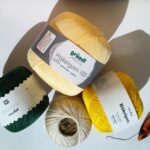
Thread can be made from different materials, each with its own advantages and disadvantages. Synthetic yarns may initially seem less ecological, but some of them can be recycled very well—provided they actually enter a recycling cycle at the end and are not carelessly discarded in the environment.
Cotton is biodegradable, but it requires a lot of water and chemicals for cultivation and processing. Mercerization, which makes the thread smoother and shinier, also requires chemicals. However, resources can be saved during the subsequent dyeing process because mercerized thread absorbs color better.
Yarn production is an international business, and the same social standards for workers do not apply everywhere. This is something to keep in mind when buying inexpensive crochet thread. Organic and fair-trade certifications are only slowly finding their way into craft yarns. Unfortunately, I do not know of any fairly produced filet crochet thread. Perhaps the demand for this type of yarn is simply too low overall? At least during my research for this article, I came across a lace thread made from Lyocell. I will test it soon and report back here.
Linen yarn could be a sustainable alternative, but it is often imported from distant countries because the infrastructure for growing and processing flax in Germany hardly exists anymore. Because linen yarn has become such an exotic material, it is even more difficult to assess the working conditions involved in its production.
Phew, that all sounds like a game you cannot win, doesn’t it? But there is a way out of this dilemma. You may have seen the sustainability pyramid. Put simply, before buying something new you should check whether you can obtain the product in another way.
- Use what you have.
Wenn Du schon einen Garnvorrat hast, dann nutze was darin ist. Stell Dir vor, Dein Vorrat ist ein kleiner Laden und Du gehst dort einkaufen. Fühlt sich doch irgenwie lustig an, oder?
Tatting can also be done with thicker threads. A thread just needs to be smooth and strong enough so that the rings can be tightened. - Repair what you have.
Well, that does not really apply to thread. So we will skip that one. - Borrow or swap.
Swapping works particularly well with yarn. If you do not like the selection in your personal yarn stash, simply exchange with like-minded people. This is easy through various groups or forums. Of course, it is best if you can find people near you and avoid long transport distances.
The advantage for tatting is that you rarely need a whole ball of thread, but it is nice to have many colors. Many people have large collections of leftover yarn that they even give away because they are happy if the remnants can still be used in a meaningful way.
If this is relevant for you, pay attention to whether people smoke in the household or whether animals live there. - Buy second-hand.
See point three. - Make it yourself.
Well… yes, in principle that is possible. But growing your own cotton in Germany would be rather inefficient. Achieving the consistent quality of commercial crochet thread would require a lot of practice—or a very large and expensive machine that would probably require building your own house for it. So: see point two. - Buy new.
If you have unsuccessfully exhausted all previous options, you are “allowed” to buy new thread. For example, if you need very specific colors and cannot find anyone who has them in their stash.
You will find various sources for yarn in my shop and product recommendations.
Always remember: you do not need much for tatting. Keep your stash manageable.
shuttle
It is hardly worth saying much about shuttles. They are so small and you only need so few of them that I consider them negligible. Wood is better than metal in terms of production impact, but metal might last longer—unless it rusts. Plastic is fine if it can be recycled at the end. Anyone who wants to be extra sustainable can make upcycled shuttles.
Tools
Crochet hooks, sewing needles, and scissors are already available in my household. They hardly wear out through tatting use, so I also consider them negligible.
Patterns
When it comes to patterns, it depends on how often we use them. If we only use them once and view them on a smartphone that we already own, digital is the better option. If we use them frequently but would need to buy a newly produced tablet just for that purpose, printing them out would make more ecological and economic sense. As a compromise, you could print only the pages with the diagrams and read the text digitally when needed.
My conclusion: The materials are not completely unproblematic, but we can reduce negative impacts through our behavior. In addition, the overall material use is comparatively low.
Lifecycle
Making
Making the lace is what we are here for. It is our hobby. That is why I included it in the lifecycle, although one could also place it under input. In the end it does not matter—as long as we do not forget this most important part.
How can an activity be sustainable? One purpose of handicrafts is to pass the time, so we can look at how long we stay busy with, for example, a single ball of thread. Without giving exact numbers, I would claim that tatting has a very good input-to-time ratio. On a good day I can knit an entire 50-gram skein. But I can spend years working on a 50-gram ball of crochet thread. That is not only due to the long yardage but also to the “holey” structure of tatting.
Besides the materials already mentioned, tatting requires a place that is not too warm and not too cold, and sufficient light. Heating or air conditioning is running anyway, so we can ignore that. A small LED lamp provides bright light and consumes hardly any electricity.
Tatting does not make our bodies consume significantly more energy than simply sitting around. So we do not need to eat more just to do tatting.
Since we ourselves are the “workers,” we have control over whether our finished work is “fairly produced.” Be mindful of your body and do not exploit it. Deinem Körper und beute ihn nicht aus.
Even if we sell the finished lace at a market, making it by hand is not very economical. Tatting simply takes a very long time. In the same amount of time, one could earn significantly more money in a well-paid job. However, unlike knitting, for example, tatting cannot easily be automated. The finished lace is therefore a highly individual product with great sentimental value.
Besides, most of us rarely want to make money from our hobby—we mainly want to enjoy the relaxation it brings. For that reason, I do not place too much weight on the economic aspect of the making process.
Use
There are many different motifs and uses for tatting (you can also read my article about the purpose of tatting). I find it difficult to say something general about sustainability here. Sinn von Occhi.). Ich finde es schwer etwas Allgemeines zur Nachhaltigkeit zu sagen.
One positive aspect is that tatting lace is very durable, and because we made it ourselves we can also repair it if necessary. Since we use relatively little thread, finished pieces can also be stored in a space-saving way.
Da wir nur relativ wenig Garn verbrauchen, kann man die fertigen Occhispitzen platzsparend lagern.
My conclusion: Producing and using tatting lace consumes few resources but brings great joy.
Dispoal
Because we use little material, we also have little to dispose of.
In order to dispose of worn-out lace properly, we would need to remember throughout its entire lifecycle which material we used. That can be a challenge—or even impossible—if we worked with second-hand leftovers without labels.
Worn-out synthetic lace belongs in a recycling system. Unfortunately, it is often difficult for ordinary consumers to see how this can actually be implemented. Even damaged but clean cotton can still be used for recycled yarn. But how does it get there? Is my plastic shuttle allowed in the recycling bag even though it is not packaging? Abroad, Germany is admired for its discipline in separating waste, but I think our system still has plenty of room for improvement.
My conclusion: When it comes to disposal, I often feel left alone. Can my cotton yarn go on the compost even if it is dyed? The manufacturer says nothing, so I prefer to throw it in the residual waste. Is my synthetic yarn recyclable or perhaps even biodegradable? The manufacturer says nothing. So I throw it—somewhat uneasily—into the recycling bag. Even if I think about it and try my best, there is not much I can achieve here myself. But once again, the low material consumption works in our favor.
Conclusion
All things considered, I think tatting performs quite well. With very little input, we can spend hours peacefully occupied, experience great success, and feel joy—perhaps even enjoy pleasant company.
Compared with hobbies such as motorcycling or chainsaw carving, tatting is absolutely sustainable. But it can even outperform other handicrafts such as patchwork or knitting.
However, as with any hobby, it is important that you only do it if you truly enjoy it. And you do not need to buy a complete set of equipment right away. Try tatting first with a single ball of thread and without a shuttle aus.
What do you do to make your handicrafts more sustainable? Feel free to leave me a comment.