Carolin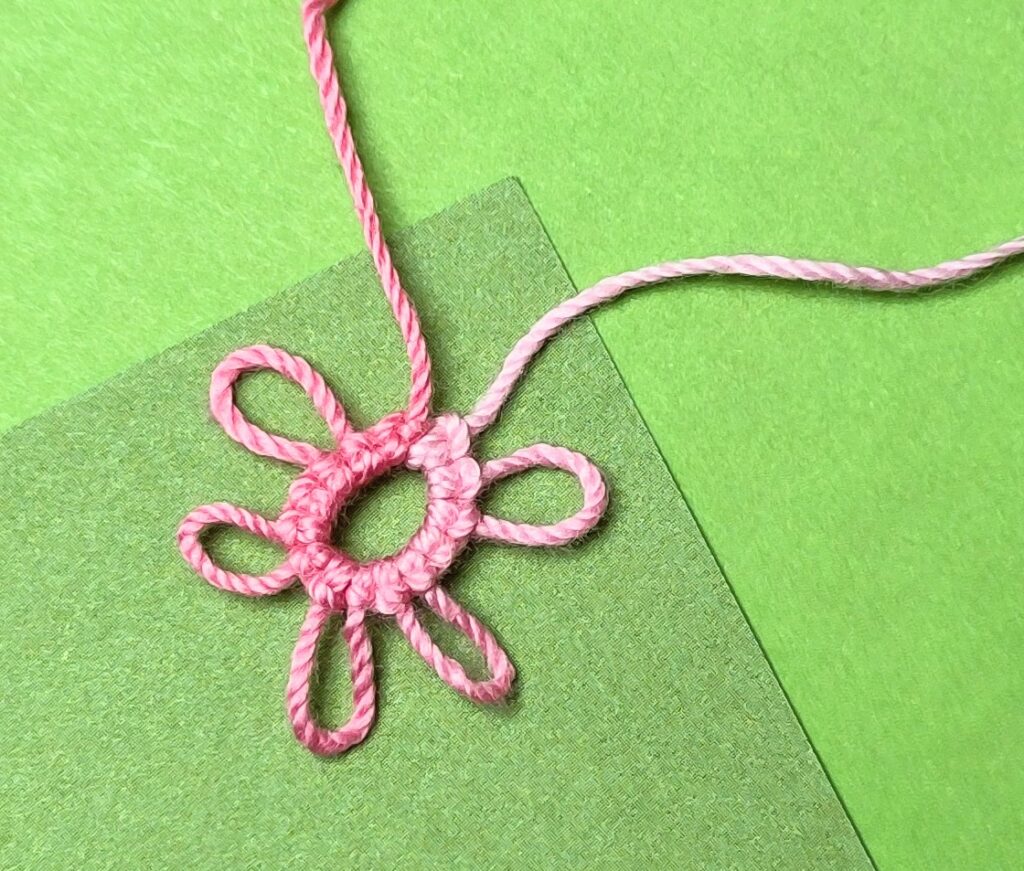
Imagine you’re starting a simple ring: 3 - 4 - 3. If your brain works anything like mine, it divides the ring into three distinct sections. One section of three stitches, one of four, and another of three. The picots are the dividers in between. Counting stitches requires concentration; picots, on the other hand, just "happen." It’s a bit like the stitch sections are distances we swim underwater, and at the picots, we surface to catch our breath. Maybe for you, picots are even a little "island of rest" before the next block of stitches. Once you reach the picot, you can unwind more thread from the shuttle, quickly check your phone, or head to the bathroom...
...or maybe you shouldn't?
What happens when we treat picots as resting spots?
Interruptions in tatting happen all the time. You have to unwind the shuttle eventually. You have to join a new thread or simply take a sip of water. Maybe the doorbell rings, or someone calls. Interruptions exist, and they aren’t a problem in themselves. However, if we always place these breaks at the picots, we never find our "flow." The picots become uneven in length, and the thread tension of the surrounding stitches becomes irregular. For a consistent result, we shouldn't do one thing at this picot and something completely different at the next. Picots aren't just gaps between stitches; they are their own elements, vital to the aesthetic of our tatting. Let’s give them the attention they deserve.
How can we do better?
Don't think in stitches—think bigger. Think in rings and chains. It benefits you on so many levels to concentrate on the entire ring, and as a result, your tatting will simply look much more beautiful. Once the ring is closed or the chain is finished, then you can do whatever you like.
Why is it so hard to save the breaks for between rings and chains?
Our brain is a reward junkie. Every time we experience a success, those feel-good hormones are released. This happens every time we finish a chain, and especially when we pull a ring closed. We know that food or exercise also triggers these hormones, but the brain likes to take the path of least resistance. If a specific activity leads to success, the brain doesn't waste energy thinking—it wants more of that same activity immediately. This means that after closing a ring, we have this hard-to-control urge to start the next one right away. We know we really need to go dust the house, but our brain wants more tatting!
Unfortunately, I don't have a genius hack for this. Only discipline helps here. With discipline, we can silence the junkie for a moment and—for the sake of the big picture—unwind our shuttle before we start the next ring.
What interrupts your favorite craft? I'd love to read it in the comments.